|
| Wharton Memorial Gardens, Bedford, Virginia |
Odd Number Plantings: When deciding on flowers for your gardens, it's always a tough decision. How many should I buy? Do I have room for three or more? Is one plant going to look too scrawny in the place where you want to plant it. Is the cost of one specific plant more than enough for your current budget.
If you are able, and you have room for them, and it fits in your budget, it's always visually appealing to plant your flowers in groups of odd numbers. By planting in groups of three, five, etc., of the same flower, that is usually more satisfying to the eye, and gives a more pleasant visual appearance. This can also be achieved by using an odd number of the same color of plants that bloom at the same time.
When you plant in odd numbers they look more natural than an even number of plants. But of course I don't always abide by that rule myself. My garden beds are not that large and also because of cost, I might only buy one plant of a specific species. I'll try that plant to see how successful it is in my garden environment, and how it holds up with our severe winters. I also like to see how big the plant gets, and if it spreads very much. I tried planting three Siberian irises one year, and they just about took over the whole garden area where I planted them in. I must have ended up with over 50 Siberian irises when I split up that grouping of three.

Balancing your garden with symmetry by using an even number of plants is more suitable for the formal garden. When you have an even number of groupings like two, four, etc. your mind is always trying to balance out the flow of the garden.
Here is an interesting article on planting your garden in groups of odd numbers: Planting in Odd Numbers; The Secret for a Beautiful Garden
Mass Plantings of the Same Plants: You can achieve a very coordinated look in your yard/gardens if you use the same color of plants throughout your flower beds. When using this technique your plants should be hardy and low maintenance. I've attempted to achieve this by using sundrops (Oenothera Frutiose 'Fyrverki') around my house which a friend of mine shared with me (thank you, Tammy). Well, I have to say that this is one of the best flowers ever. They thrive in full sun, but will also do fine in some shade. They do re-seed easily, and will spread out from runners in the shape of rosettes, but they are easy to pull out if they start getting invasive in an area. I've planted them all over and they add spots of color and highlights in my yard. They seem to do well in just about any soil condition. And the leaves have some red on them. They do not do well in poorly drained soil. I just wish the bloom time was longer for them. However, the stems and leaves stay attractive until fall, and the leaves will have additional red coloring in them. Here is some additional information on Mass Planting.
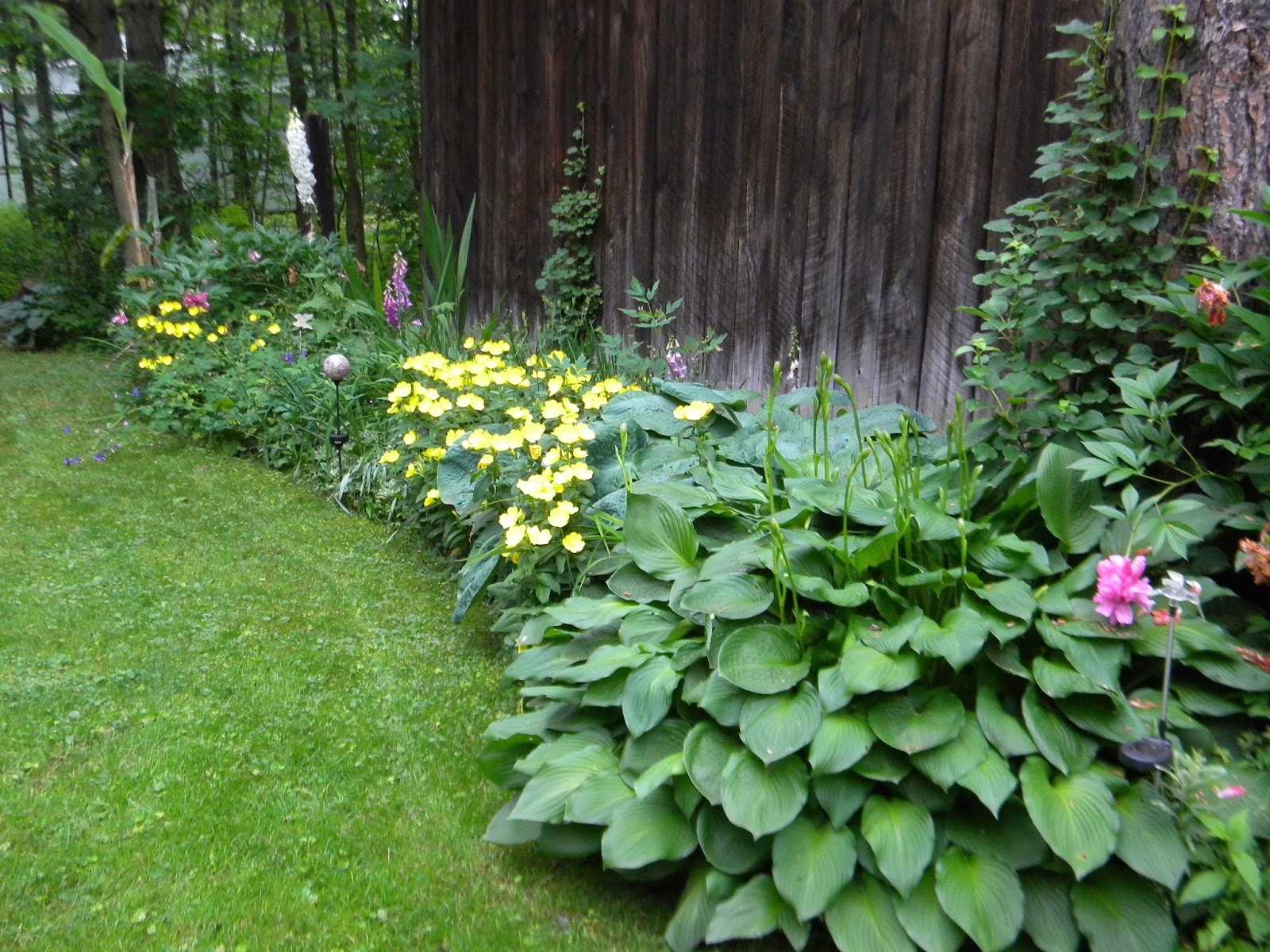 |
| Sundrops (yellow flowers) |
Foliage Texture and Color: You might try adding various plants that have a different leaf texture or color. This creates a contrast and adds interest in your garden. One way to achieve this would be by adding some variegated plants. You can also mix it up by adding some different colored hostas or coral bells (Heuchera). The heuchera are now available in several different colors of reds, rust, lime green, and mixed colors of all of the above.
 |
| Left- Hosta (unsure of variety), Burgundy Heuchera, and Campanula Blue Waterfall (not in bloom yet) |
 |
| Variegated Solomon's Seal, ferns growing behind them, and ivy at the base. |
Curved Borders and Edgings: Another simple design principle is the use of curved edges surrounding your flower beds, lawns, and borders. When you have a curved edge in your garden, your eye is following it and not stopping at the 'end' of the line. It creates a softer line while a straight border appears to create a hard edge. It also creates mystery about what's going on around that curved edge, and it appears to be a more natural border with a nice flow.
 |
| Curved walkway and borders. This photo and the one below is from the Wharton Memorial Gardens, Bedford, Virginia |

While both walkways are visually appealing, the curved walkway in the photo above this one offers more interest.
You do not have use bricks or stones to add a path. You can do it with your grass/lawn by mowing an area into a pathway. There are several materials you can use as well such as gravel and mulch. Here is a link with some photos of garden borders and paths and the materials used for the paths: 9 Ways to Create a Garden Path
Even if you are not interested in doing a path the photos are beautiful and demonstrate the curved borders very well.
 |
| This is one of the paths in our backyard. |
There are really no rules when it comes to YOUR Garden! It's your garden and you can do what you want and what appeals to you. If you don't like something after a few years or if you have a plant that's too fussy, dig it up and give it away to a friend or toss it out. Or if it's doing great you can propagate it and increase your number of plants.
Here is a list (alphabetical order) of Common Plant Names and suggested uses for that specific plant: Common Plant Names
 |
| Eastern Phoebe with bug in it's beak |
 The Phoebes construct their nests of mud and grass, and usually in a protected area such as under a bridge, a barn, house or shed. The bird in the photo above is using the same nesting spot that they did last year which is on the side of our pole barn (pictured at left). I haven't been able to get a photo of them on the nest (yet). Right now I'm pretty sure their eggs have hatched because they've been busy flying back and forth to the nest.
The Phoebes are found in open woods such as parks, woodland edges, and yards.
"Design is not just what it looks like and feels like. Design is how it works."
~ Steven Jobs

You can never have enough toads in your gardens!
Thanks for taking the time
to read my blog post.
Feel free to leave a comment.
#Garden #GardenDesign #GardenPaths #EasternPhoebe #Nature #Blog #Blogging